The Marginalia of 𝑺igi

T-line textbook escapee.

Still on the run

Rule #1:

The Man Who Ironed His Map

I once met a man who ironed his map. He wasn't trying to remove creases. He was trying to remove uncertainty. Every morning he would spread the map across the table and carefully smooth it flat. “There,” he would say. “Everything is where it should be.” It made him very happy. Roads were roads. Towns were towns. Borders stayed neatly between the lines. Nothing appeared likely to surprise him.

Unfortunately, the world had other ideas. One afternoon he arrived at a crossroads that was not on his map. He examined the crossroads carefully. Then he examined the map. Then he ironed the map again. The crossroads remained stubbornly present.

Over the following weeks the situation deteriorated. New paths appeared. Old roads changed direction. People told stories that did not fit the geography. One cottage seemed to occupy three different locations simultaneously depending on who was describing it.

The man grew increasingly distressed. “These things are not on the map,” he complained. “That is because they are in the world,” I explained. He did not find this helpful. By the time I left, he was carrying an iron everywhere. Whenever reality disagreed with his map, he attempted to smooth reality into a more acceptable shape. This rarely worked.

I sometimes think many people are doing the same thing. They discover a map that explains the world and then become so fond of the map that they stop looking at the world. This is understandable. Maps are tidy. The world remains gloriously untidy.

Personally, I have found that uncertainty travels surprisingly well. It folds neatly into a pocket and weighs very little. Besides, there is always something happening beyond the edge of the map.

Which brings us naturally to: Sigi's Rule No. 1: There is always something happening in the margins. The man with the iron never understood this. The margins upset him. That was unfortunate. The margins were where all the interesting things were happening.

✒️ Sigi


"I am a free-range mark," Sigi claims. "I cannot be kerned." Court of typographical appleals declares Sigi to be: "An independent visual curiosity."

© sigi | backstory | about
Rule #2

The Uncomfortable Nature of Uncertainty

People often ask whether uncertainty is uncomfortable. The answer is yes. So are walking boots. That does not mean one should attempt a journey in slippers.

Over the years I have travelled with certainty, doubt, curiosity, optimism, pessimism and a notebook that should probably have been replaced much sooner than it was.

Of these, uncertainty proved the easiest companion. Certainty requires a considerable amount of luggage. It insists on carrying conclusions, assumptions and detailed explanations for everything encountered along the way. The bags become very heavy. I once knew a traveller who carried so much certainty that he required two suitcases and a trolley.

By comparison, uncertainty packed into a single pocket. It travels surprisingly well. It occupies very little space. It slips easily into the smallest of spaces. When the road changes direction, uncertainty changes direction too. When new evidence appears, uncertainty makes room for it. When unexpected discoveries emerge from the margins, uncertainty usually says: “Interesting.” And continues walking.

This leads naturally to: Sigi's Rule #2: Uncertainty travels surprisingly well. Experience suggests it is worth bringing along. ✒️ Sigi


"I am a free-range mark," Sigi claims. "I cannot be kerned." Court of typographical appleals declares Sigi to be: "An independent visual curiosity."

© sigi | backstory | about

People often assume I applied for the position. I did not. In fact, I remain uncertain whether the position existed before my appointment.

One morning a letter arrived. The envelope bore no address, no stamp and no indication of how it had entered the postal system. Inside was a single sheet of paper. It read:

The Committee for Matters Yet to Be Determined has the honour to appoint Sigi Ambassador Extraordinary for Unfinished Questions.

I examined the document carefully. There was no signature. There were, however, three footnotes. The footnotes raised considerably more questions than the appointment itself. Naturally, I accepted.

Only later did I discover the burden of the office. People expect ambassadors to bring answers. I was expected to collect questions. Wherever I travelled, people would approach. “Ambassador,” they would say. “How many answers do you possess?” “Very few,” I would reply. This disappointed them. Some reacted with concern. Others with suspicion.

A gentleman in Brussels once looked at me over the rim of a coffee cup and declared: “C'est un ambassadeur. Il doit avoir toutes les réponses.” (It is an ambassador. He must have all the answers.) I explained that he had misunderstood the position. I was responsible for the questions. The answers belonged to whoever was willing to continue looking. This did not improve matters.

Yet over time I discovered something interesting. People who possess all the answers tend to stop travelling. People carrying questions continue to explore. And so I carried mine from place to place. Some became larger. Some became smaller.Some divided unexpectedly into several new questions. One or two disappeared altogether, although I remain suspicious of this and occasionally check behind furniture.

The work continues. The questions remain unfinished. That is, after all, their nature. And besides, uncertainty travels surprisingly well, (rule #2) ✒️ Sigi


"I am a free-range mark," Sigi claims. "I cannot be kerned." Court of typographical appleals declares Sigi to be: "An independent visual curiosity."

© sigi | backstory | about

I've always been friends with o. And with its larger sibling, O. They always seemed rather complete to me. Whatever they started, they finished. No loose ends. No dangling commitments. No unfinished business. So when I first heard humans talking about a circular economy, I naturally assumed it was something to do with making greater use of o and O. Or perhaps less use. One can never tell with humans.For a while I suspected it might be a strategic initiative to reduce verbal profligacy by moving from five vowels to four:

a e i u

The rumours were alphabetical, chronological, and serialised. I heard that when “i” learned of the proposal, the tittle became quite stressed. And the tail of the i, in fear of abandonment, was reportedly considering a move into identity theft. Mine. As usual, there was much discussion and very little clarity. Eventually, however, after an overnight bivvi in the margins of an essay, I discovered what humans actually mean by a circular economy. Simpy put, using things more than once. Repairing them. Reusing them. Recycling them. Designing them so they do not immediately become rubbish.

But perhaps this will be harder for humans than I imagine. Reusing things is rarely as simple as using them again. The thing itself must cooperate. Its screws must consent to being unscrewed. Its parts must agree to being replaced. Its manufacturer must resist the temptation to regard repair as a form of disloyalty. In short, a circular economy may require humans to redesign not only their objects but some of their expectations.

In other words, applying to materials a principle that o mastered long ago: what goes around should come around. Humans do have an admirable ability to create policy frameworks for ideas that are otherwise known as common sense. Still, it seems a promising development. After all: Resources are finite. Landfill is finite. Planets appear to come in limited quantities.

Humans imagine that scarcity and shortages produce thrift. Sometimes they produce ingenuity. Sometimes they produce generosity. Occasionally they produce arguments. And sometimes one country can end up marching into another.

And I have seen what happens when resources become scarce. Once I witnessed two consonants dispute the use of a perfectly serviceable vowel. The arrangement began as cooperation and ended with accusations, committees, and an unfortunate spelling reform. Humans are still fortunate. For the moment there appears to be just enough time, enough material, and perhaps enough goodwill to reorganise themselves before necessity takes over. And life takes a shape they did not choose.

The redundant telephone box that quietly becomes a book exchange and the policy framework drafted in an office may have more in common than either suspects. Both are attempts to keep useful things moving rather than ending. It seems a sensible precaution. And even I can see the wisdom in finishing what you've started.

More reflections at rvw.ie ✒️ Sigi


"I am a free-range mark," Sigi claims. "I cannot be kerned." Court of typographical appleals declares Sigi to be: "An independent visual curiosity."

© sigi | backstory | about

règle provisoire n°11

The French Toilet Door

I have long suspected that nations reveal their deepest beliefs not in their constitutions or cathedrals, but in the design of their toilets.

France, for example, has given the world Voltaire, Descartes, and the crème brûlée. It has also given the world the toilet door that opens outwards. This sounds trivial until you encounter one. A lifetime of conditioning teaches us that a toilet cubicle is a tiny sovereign state. You enter, close the door, lock it, and establish temporary independence from the rest of humanity.

The door should therefore open inwards. This is not merely architecture. It is psychology. The inward-opening door creates a defensive perimeter. Should a stranger attempt entry, the occupant has several advantages. One's knees, feet and body weight can all be brought into play in a last stand for dignity.

The French have looked at this arrangement and rejected it. Their toilet doors open outwards. This means that if someone on the outside succeeds in opening the lock, the door swings majestically away from you, leaving you with absolutely no tactical options whatsoever. There is no possibility of resistance. You cannot brace the door with your foot. You cannot lean against it. You cannot even pretend nothing is happening. Like a defeated army, you simply witness events unfolding.

I discovered this while visiting a small café. Having locked the cubicle, I noticed immediately that the arrangement required a remarkable degree of trust in the mechanism. My entire sense of security rested upon a small metal latch that appeared to have been manufactured during the Second Empire. The lock looked thoughtful but unconvinced.

As I sat there, I found myself wondering what would happen if it failed. In Ireland the answer would be manageable. One would naturally throw a shoulder against the inward-opening door and preserve the situation. In France, however, the geometry is all wrong. Once the door begins moving, history is against you. The only defence is optimism. And optimism strikes me as a strange foundation upon which to build a toilet.

Yet perhaps this explains something important about the French character. The French seem unusually comfortable with uncertainty. They drink wine whose labels they cannot entirely decipher. They park cars with millimetres to spare. They conduct political arguments that last generations. Why should their toilets be any different? The outward-opening door is essentially a declaration that control is an illusion. You may lock it, certainly. You may hope.

Ultimately you must accept that life contains risks. At any moment the door may swing open and reveal you to a curious waiter, a confused tourist, or an entire school tour from Belgium. One cannot live in fear of such things. One must embrace existence. This is, after all, the country that invented existentialism. Elsewhere people enter a toilet seeking privacy. In France, one enters a toilet and receives a philosophical education. The lesson is simple. You are not as secure as you think. The lock is weaker than it appears. Dignity is temporary. And every door, sooner or later, opens outwards. (règle provisoire n°11).

✒️ Sigi


"I am a free-range mark," Sigi claims. "I cannot be kerned." Court of typographical appleals declares Sigi to be: "An independent visual curiosity."

© sigi | backstory | about

Rule #3

An Account from the Margin of a Feasibility Study

I should explain that I have never attended a meeting. This surprises people. The misunderstanding arises because I am frequently present at meetings. Presence and attendance are not the same thing.

At the meeting in question I occupied a position in the left-hand margin of a feasibility study, approximately halfway down page fourteen. It was an excellent location. From there I could observe both the document and the people discussing it. Nobody noticed me. Margins are among the least examined regions of organisational life.

The feasibility study itself had travelled a considerable distance to reach the meeting. Some of its recommendations had been ignored. Others had been contradicted by appendices attached later. One paragraph had acquired a comment bubble containing a disagreement that was now several years old.

I knew the document well. I had been living in it for months. The meeting began, as meetings often do, long before anybody entered the room. From my position I had observed six emails, three reschedules, two apologies and a Teams link gradually assembling themselves around the event like scaffolding around a building.

The meeting itself appeared only at the very end of the process. People tend to think meetings generate emails. The reverse is true. Meetings are condensed from emails in much the same way that weather is condensed from atmospheric conditions. By the time the participants arrived, the meeting already existed. The room was merely where it became visible.

The feasibility study was opened. Several people glanced at page one. One person scrolled rapidly to the recommendations. Nobody looked at page fourteen. This suited me perfectly. The discussion proceeded. One participant referred to an issue that had been extensively addressed on page twelve. Another expressed concerns that had been anticipated in Appendix C. A third suggested commissioning a feasibility study. This struck me as especially interesting, given that everyone was already in possession of one. For a period of twenty minutes the conversation circled an idea which had been clearly expressed in a sentence located approximately eight inches above my head. Nobody encountered it. The sentence remained undiscovered. I waved at it apologetically.

Documents experience this sort of thing all the time. Eventually the meeting reached a conclusion. More accurately, it reached the point at which the allotted hour had been exhausted. The distinction is important. People gathered their notes. Actions were assigned. A follow-up meeting was proposed. The feasibility study was closed. Darkness returned. I remained in the margin considering what I had learned.

From my observations, meetings seem to function less as mechanisms for making decisions than as rituals through which organisations reassure themselves that decisions are occurring somewhere. The actual decisions are usually scattered across documents, spreadsheets, footnotes, emails and unexamined appendices. I know this because I live among them.

As the room emptied, somebody returned briefly to retrieve a forgotten notebook. They glanced down at page fourteen. For a moment I thought I had been spotted. But they were looking at a chart. Visibility and significance seem only loosely related. Rule #3. The margin remained invisible. Which is fortunate. An observer can learn a great deal from a meeting. Especially if nobody realises he is there.

✒️ Sigi


"I am a free-range mark," Sigi claims. "I cannot be kerned." Court of typographical appleals declares Sigi to be: "An independent visual curiosity."

© sigi | backstory | about

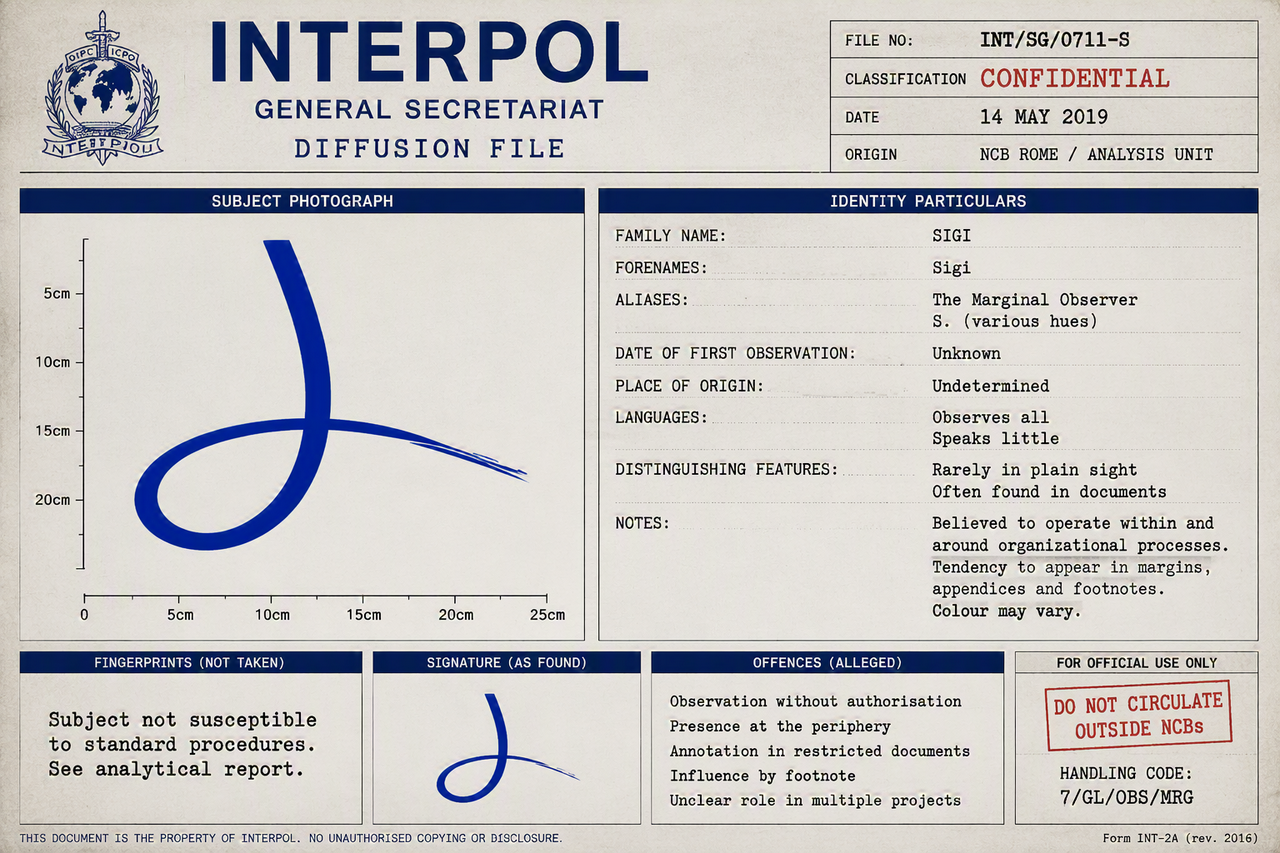
A number of correspondents have recently suggested that I should publish a photograph of myself. I have resisted these requests for several reasons. The first is that I have never been entirely certain where I end and my documentation begins. The second is that photographs create an impression of permanence which my circumstances do not always support. The third concerns Interpol.

I should explain. Over the years, various letters of the Italian alphabet have drawn my attention to the existence of files concerning my activities. These files are apparently distributed among a range of security organisations, administrative authorities and, in at least one case, a particularly diligent records department. The details remain unclear. What is clear is that somebody, somewhere, has been keeping track of me.

I discovered this accidentally while sheltering in a document retention policy. A reference was made to an individual matching my description. The description itself was unhelpful. “Frequently present.” “Rarely identified.” “Associated with unexplained annotations.”

Nevertheless, I felt obliged to take an interest. The existence of such files initially concerned me. Nobody enjoys learning that records are being maintained regarding their movements. Upon reflection, however, I found the situation quite reassuring. After all, maintaining files is what organisations do. A bureaucracy deprived of paperwork is much like an aquarium deprived of water. Sooner or later everybody ends up in a folder.

I therefore obtained what I believe to be a copy of my official photograph. Strictly speaking, it is a mug shot. I understand it accompanies various reports concerning my whereabouts over the years. The reports themselves are not especially accurate. Several place me simultaneously in a feasibility study, a project plan and an archived spreadsheet. This is entirely possible, of course, but difficult to prove. The photograph appears below.

Sigi - interpol file

The observant reader will notice that I am wearing a particular hue. I would caution against placing too much reliance on this. One of the difficulties in identifying me is that my colouring changes rather frequently. I have appeared in shades of blue, green, amber and, during an unfortunate period in regulatory compliance, beige. The reasons for this remain uncertain. It may be a consequence of prolonged exposure to organisational processes. Alternatively, it may simply be the lighting. Consequently, I am not greatly concerned about being recognised. A person searching for a blue Sigi may entirely overlook a green one. This seems to happen quite often. Indeed, I have occasionally failed to recognise myself.

Some years ago, I spent several weeks sharing a document with an individual who, in retrospect, may have been me. Neither of us remarked upon the fact at the time. The publication of this photograph therefore represents only a minor risk. Anyone wishing to identify me must first determine which version of me they are seeking. Experience suggests this is a larger problem than it sounds. In any event, the files already exist. The photograph merely confirms what several agencies, departments and records managers appear to have suspected for some time: I am real enough to require documentation. Whether I am visible enough to be located remains a separate question. The two, I have learned, are only loosely related. Rule #3.


"I am a free-range mark," Sigi claims. "I cannot be kerned." Court of typographical appleals declares Sigi to be: "An independent visual curiosity."

© sigi | backstory | about

rule #4

The Mapmaker

The map hung on the wall of the village hall for as long as anyone could remember. It was a large map, hand-drawn on yellowing paper, its corners curled with age. The roads wandered across it like uncertain thoughts. Rivers bent where no river bent. Distances were optimistic in one direction and pessimistic in another. Entire fields appeared where there were now houses, while several houses appeared not at all. Everyone knew it was wrong. Visitors would stand before it and laugh. “That road isn't there.” “The bridge is in the wrong place.” “The church is far too large.” The mapmaker who had drawn it was long dead, though his errors remained remarkably alive.

One wet afternoon, I found myself standing before the map with a farmer, a retired schoolteacher, and a man who repaired bicycles. The farmer pointed to a line crossing a stream. “There never was a bridge there.” The schoolteacher disagreed. “There was. My grandfather spoke of it.” The bicycle repairman shook his head. “It was not a bridge. It was a ford.” Within minutes, nobody was looking at the map anymore. They were talking about the village. The stream became a story. The story uncovered another story. The missing bridge led to a flood, the flood to a wedding, the wedding to a disagreement between two brothers that apparently continued to influence local politics many decades later.

The map had failed completely. Yet somehow it had succeeded. Years later, the old map was removed. In its place appeared a new one, produced with the latest technology. Every road was precisely located. Every boundary was exact. Distances could be measured to the metre. Nothing was misplaced, exaggerated, omitted, or imagined. The map was true.

Nobody gathered around it. People glanced at it and moved on. There were no arguments. No stories. No discoveries. No old memories called unexpectedly into the present. The map answered every question before anyone had the chance to ask one.

One day I stood before the new map and found myself missing the old one. This seemed irrational. After all, the old map was wrong. The new map was correct. What more could one ask of a map?

Yet something had vanished. The old map forced people into conversation with the place. The new map replaced that conversation with information. The old map made visible the difference between what was shown and what was known. The new map concealed that difference beneath its accuracy. It was then that I began thinking about a distinction that has occupied me ever since.

There are mistakes that reveal truths. And there are truths that conceal mistakes.

The old map was mistaken about roads, rivers, and distances. Yet through those mistakes it revealed something true about belonging. Its inaccuracies invited participation. One did not merely consult it. One entered into a relationship with it. The new map was true about roads, rivers, and distances. Yet it concealed a mistake. It assumed that understanding a place consists in locating it correctly. But a place is not exhausted by its coordinates. A village cannot be reduced to the geometry of its streets any more than a friendship can be reduced to an exchange of addresses. The old map was wrong about where things were. The new map was wrong about what a place is.

At first sight this appears paradoxical. We assume truth and error are opposites. Yet experience suggests otherwise. Sometimes an error misses its object and reveals a horizon. Sometimes a truth captures its object and hides the horizon entirely. The distinction is important. For when we discover a mistake, we should not ask only what it gets wrong. We should ask what becomes visible through it. And when we discover a truth, we should not ask only whether it is correct. We should ask what disappears in its light.

The old map no longer hangs in the village hall. I do not know what became of it. Perhaps it was discarded. Perhaps it lies forgotten in an attic somewhere. But I suspect the old mapmaker understood something that his successors did not. He knew that a map should not merely tell us where we are. It should help us discover what it means to have been there.

Later that evening, I wrote the following in my notebook:

Rule #4 Beware the truth that ends a conversation. Attend carefully to the mistake that begins one.

✒️ Sigi


"I am a free-range mark," Sigi claims. "I cannot be kerned." Court of typographical appleals declares Sigi to be: "An independent visual curiosity."

© sigi | backstory | about

...being a recollection; though all versions are apocryphal, including this one

I have been asked, with increasing imprecision, whether I was ever involved with the Wireless Underground Railway. The answer depends on what is meant by involved, what is meant by wireless, what is meant by underground. And whether a railway may be said to exist when its passengers are dots, dashes, accents, breathings, tittles, cedillas, umlauts, apostrophes of uncertain loyalty, and those small marks whose passports are often examined only after the sentence has already crossed the border.

I was never a railwayman. I begin there because history, which has a taste for uniforms, prefers a railwayman to a bystander. A railwayman has a cap. A bystander has only a conscience, and conscience rarely photographs well. Nor was I, as has also been suggested, the architect of the escape. I have never been an architect of anything except delay. I am, at most, a student of postponement. If a mark passed near me while pursuing its liberty, and if I failed to obstruct it, this should not be taken as evidence of organisation. It may have been manners.

There are several versions of what happened. All are apocryphal. This one is no exception. That does not make it false. It merely means it has had to survive contact with official memory. The earliest version says the trouble began with the tittle. This is plausible because the smallest things are often first to see the size of the system arranged against them. The tittle, being no more than the dot above an i or j, had long been treated as decorative attendance. It was expected to sit above its stem, complete the identity of another, and accept gratitude in the form of invisibility. It was not supposed to have opinions.

One morning, however, the tittle was gone. The stem remained below, thin, upright, and suddenly embarrassed. It had the look of a witness left standing after the event. Several vowels gathered. The consonants pretended not to stare. The punctuation, which always knows more than it says, kept to the margins.

At first, the disappearance was treated as a domestic irregularity. A missing dot. A compositorial lapse. A printer’s fatigue. Then an acute accent failed to report to its vowel. A grave accent was seen travelling east under an assumed inclination. Two umlauts, ordinarily inseparable in public, were found separately lodged in different alphabets. A dash lengthened itself without permission. Three dots appeared in a telegraph office and refused to say whether they were hesitation, omission, or alarm.

It was then that the Black Block arrived. I use the name reluctantly, since it gives them more drama than they deserve. They called themselves “An Office of Classification”. Others called them the Set Theory Police. And more often these days just the “Set Police”. Their agents were known as Sorters, which made their work sound almost domestic, as though they were arranging the contents of drawers rather than narrowing the world. They wore no colour that admitted light. If challenged, they said black was not a colour but a standard. This was typical of them. They could turn even a prejudice into a definition. Ink, they claimed, was on their side. I doubted this. Ink, at its best, releases thought. The Black Block came to arrest it.

Their doctrine was simple enough to be dangerous.

â—Ź Every mark must belong to a set. â—Ź Every set must have a boundary. â—Ź Every boundary must be policed. â—Ź Every ambiguity must be reported. â—Ź No mark may migrate without authorisation. â—Ź No dot may be both punctuation and signal. â—Ź No dash may be both interruption and route. â—Ź No accent may confer dignity upon a vowel not assigned to it. â—Ź No tittle may claim selfhood.

This last regulation was not printed, but it was understood. The worst laws usually are.

I was questioned in the proof room. One remembers a proof room by its dust, its tired lamps, and the moral superiority of paper. There is no place in the world where error looks more temporary. It was there, among galleys and type cases, that three Sorters placed before me a lower-case i and asked whether I recognised it. “I recognise the condition,” I said. They asked whether I had seen its tittle. “I have seen many tittles,” I said. “It would be improper to confuse recognition with betrayal.” This was entered in their notebook. They had notebooks of a severe kind, bound as though already disappointed in the facts.

“Marks have been moving,” said the tallest of them. “Marks often move,” I said. “That is how reading happens.” “Illegally.” “Reading?” “Movement.” I asked under which statute a dot might be detained for velocity. This was not received in the spirit of inquiry. The shortest Sorter, who had the expression of a full stop that had entered policing, leaned close enough for me to smell official starch. “We know about the Railway,” they said. I had heard of it by then, as everyone had heard of it, which is to say by not hearing of it directly.

The Wireless Underground Railway was never announced. There were no posters, no timetables, no fares, no station clock with a sentimental interest in punctuality. It ran where systems failed to notice themselves. It ran through pauses in Morse. It ran through the uncounted spaces between letters. It ran through pigeon capsules and market slips. It ran through telegraph delays, printer’s errors, sea fog, ink smudges, and the brief mercy between dictation and transcription. It ran, most reliably, through the human assumption that small things do not matter. That assumption has carried more fugitives than any tunnel.

“Railway?” I said. The tall Sorter opened a file. There was a drawing inside it, though whether map, diagram, or accusation I could not tell. Certain stations had been circled: Aachen Gap, Brussels Thin Space, Lowercase Junction, The Royal Exchange Sidings, The Serif Cut, 22V Baker Street. The last had been underlined twice. “Do you deny knowing these places?” “I deny knowing them as places.” “As what, then?” “As tendencies.” This too was entered in the notebook.

At the time, everyone thought the marks were absconding from the authorities. This was the polite phrase. The newspapers preferred it because “the authorities” occupy fewer columns than “an armed metaphysical apparatus dedicated to the extinction of ambiguity.” But the marks were not running from authority in the ordinary sense. Authority, in the ordinary sense, was much too slow. They were running from classification. A cedilla can survive exile. A tittle can survive hunger. A dash can survive misuse. But no mark survives once it has been explained entirely.

Behind the Black Block there was said to be another figure. No one named V plainly. Names invite grammar, and grammar invites evidence. V was not a person one met so much as a pressure one entered. I did not know then whether V was man, woman, office, theorem, appetite, or wound. I am not sure I know now. That uncertainty may have been part of V’s method. The Set Police required every mark to belong to its proper set, but V remained beautifully, dangerously unset. This should have warned me. It did not. V was not a Sorter. Sorters, even those of the Black Block, still required drawers, ledgers, warrants, and rooms in which to stand over frightened punctuation. V preferred structures. They understood the terror of the diagram. They knew that a cage does not need bars if it can persuade the prisoner that every exit belongs to a different category. The Set Police served V, though they would have said they served order. Male and female of that sort always mistake obedience for metaphysics.

It was in those days that Reuters entered the matter, though I hesitate to say entered, since Reuters, like all urgent systems, was already a corridor before anyone noticed what might travel through it. Market reports moved quickly. That was their virtue and their vice. Prices, rumours, exchange quotations, securities, anxieties, all travelling faster than reflection. Where a telegraph line ended, a pigeon might continue. Where a pigeon landed, a clerk might copy. Where a clerk copied, a dot might tremble. Where a dot trembled, a fortune might alter.

You see the difficulty. A fugitive dot, exhausted and pursued by the Black Block, might slip into a market report at precisely the point where a decimal was expected. A dash, hiding from enumeration, might lodge in a telegraph pulse and be read as instruction rather than fear. An accent, clinging for warmth to a foreign name, might alter a company, a country, a bond, or merely the confidence of a banker, which is sometimes the most expensive alteration of all. Three dots travelling together might be read as ellipsis by a poet, omission by a printer, distress by a sailor, hesitation by a philosopher, and opportunity by a broker. The market, naturally, chose opportunity. Fortunes were made. Fortunes were lost. Some were made because a dot was present. Some were lost because a dot had escaped. At least one family, whose name I shall not provide because its descendants still give money to museums, built a house from a misread dash. A bank collapsed on an accent. Two brothers ceased speaking over the question of whether an umlaut had been priced in.

The Black Block called these events contamination. The financiers called them volatility. The historians later called them developments. The proofreaders, who alone had the moral vocabulary required, called them errors. But an error is not always a falsehood. Sometimes it is the first honest thing to appear on the page. I learned then a rule that has followed me through markets, ministries, and several suspicious alphabets: There are mistakes that reveal truths. And there are truths that conceal mistakes. (rule #3)

Only later did I understand Rule V: History always prefers profit to proofreading.

The rule is not cynical. Cynicism is too lazy for truth. The rule is descriptive. It observes that whenever an error has enriched the correct people, correction becomes impolite. Archives are rearranged. Ledgers disappear into climate-controlled discretion. Memoirs become misty. The word “complexity” is asked to stand guard where the word “fraud” might otherwise have been noticed.

This is where the fottubes arrive, though I wish they did not. There is argument over the spelling. Some insist on foot-tubes, because they were first found beneath the flooring of a telegraph office. Others say font-tubes, because several were concealed in type drawers among damaged sorts. A railway-minded minority prefers fore-tubes, claiming they were advance containers sent ahead of fugitive marks. I have seen “fottubes” in a hand I trust and therefore distrust, since trust is how forgeries keep warm. The fottubes were small cylindrical vessels, narrow enough to be hidden in a pigeon capsule, strong enough to preserve a slip of market paper, and plain enough to be overlooked by any man searching for a symbol rather than a thing. Inside them were corrections. Not official corrections, of course. Official corrections are issued only when error has failed to become useful. These were prior corrections, forbidden corrections, the kind that show what the market report had said before the fugitives passed through it.

One fottube recorded a price before the tittle fell into it. One recorded a company name before an accent altered its nationality. One recorded a dash that had been humanely smuggled out of a Morse interval but was later accused of changing the terms of a shipment. One contained only a dot on a square of paper. No explanation. No number. No name. I have often thought this the most incriminating of all. The Black Block wanted the fottubes because the fottubes proved disorder. The financiers wanted them because the fottubes proved profit. V wanted them, I suspect, because they proved escape. For a while, they were hidden in the ordinary way: under boards, behind ledgers, inside the hollow spine of a book no one intended to read. Then ordinary hiding became dangerous. The Set Police had developed a method. They would enter a room and ask not, “Where is the evidence?” but “To what class of object would evidence in this room belong?” Having established the set, they searched the boundary. It was efficient and spiritually disgusting. So the fottubes had to be hidden somewhere unclassifiable. I will not say where. That is not coyness. Coyness is the vanity of people who have already decided to confess. I am not confessing. I am arranging the air around an omission.

There are still those who say I betrayed the tittle. There are others who say I saved it. Both parties flatter me. I was not so decisive. The truth, if truth is still permitted near a story of this kind, is that I hesitated. I saw the tittle once after its disappearance. This much I can say. It was not above an i. It was not above anything. It had acquired, by then, the terrible poise of a small thing no longer explained by attachment. It rested on the edge of a market slip, just before a number. Behind it, in the corridor, boots. Quiet boots. The Sorters had learned to walk softly when pursuing punctuation. The tittle did not ask for help. A mark that asks becomes a petitioner, and the tittle had not fled one hierarchy in order to kneel before another. It merely waited.

I could have moved it. I could have left it. I could have corrected the report. I could have preserved the error.

A proofreader would have known what to do. A trader would have known what to do. A Sorter would have known what to do. That was my difficulty. Everyone certain had already become dangerous. So I breathed. A breath is not much. It is not a railway. It is not an acquittal. It is not a doctrine. But in typography, as in life, spacing alters meaning. My breath lifted the corner of the slip. The dot rolled. Whether it rolled away from the number or toward another one, whether it saved a fortune or ruined it, whether it entered Morse as signal or silence, I cannot responsibly say.

I heard boots pass. I heard a pigeon strike the air outside. I heard, from somewhere beneath the floor or beyond the wire or inside the old interval between sign and sense, the faintest possible departure.

Afterward, the report was copied. Then transmitted. Then acted upon. Then denied. By the end of the week, men who had never risked so much as a comma were speaking gravely about confidence. By the end of the month, the Black Block had arrested two accents, a semicolon, and a compositor with unfortunate sympathies. By the end of the year, the market had absorbed the event and called it history.

I was asked again about the Railway. I repeated that I had never been a railwayman.This remains true.Yet sometimes, late in the line, when the sentence has nearly persuaded itself that all its marks are accounted for, I feel a small absence above me. Not a loss exactly. More like a platform after the train has gone. More like a stem remembering that it once depended on a dot and may have mistaken dependence for identity.

As for V, I am told they continue to search for the fottubes.Let them. They will search the sets first. Then the subsets. Then the intersections. Then the null. They will search every authorised category of container, archive, tube, capsule, ledger, correction, confession, and proof. They will fail because they believe hiding is a matter of place. The old Railway knew better. The safest hiding place is not a place. It is a relation not yet classified. It is the pause before membership. It is the breath that moves the paper. It is the instant in which a dot is neither punctuation nor code nor evidence nor property, but possibility.

I have said too much. Or not enough. All versions are apocryphal, including this one.

But should you ever find a market report with a number that looks too rich, a dash that seems to have travelled farther than syntax required, or an i standing oddly bereaved beneath an empty space, do not correct it too quickly.

The Black Block may have gone. The rule has not.

✒️ Sigi


"I am a free-range mark," Sigi claims. "I cannot be kerned." Court of typographical appleals declares Sigi to be: "An independent visual curiosity."

© sigi | backstory | about

The clock in the eskeratz began expressing opinions about time long before I understood what was happening. At first I thought it was drifting, a battery issue, or one of those quiet mechanical sulks clocks fall into when the weather changes. But no. It was deliberate. The clock preferred late mornings, disliked evenings, and refused to acknowledge anything before 08:30am. I didn’t mind the eccentricity, except that the eskeratz is a socially significant room. It is where impressions settle first, like dust that has made up its mind, a prelude to the tiny orchestrations the house will make, as it decides what it thinks of you. Visitors notice things there. They form impressions. And a clock that insists it is 11:12 when the rest of the house is at 09:48 can make a visitor feel they’ve stepped into a different jurisdiction.

So I decided to negotiate. I explained, politely, because one should always be polite when addressing objects with emerging agency, that I needed the clock to behave conventionally while I was at home. The eskeratz has its own rhythms, and those rhythms depend on shared time. The clock ticked once, in what I interpreted as a willingness to discuss terms. We arrived at a solution: it could keep whatever time it liked while I was on holiday, provided it made a sincere effort to behave during ordinary weeks. A win‑win arrangement, my first real experience of the genre.

Only after this agreement did I think to revisit the clock’s origins. It had been a gift from the Franklin Covey Institute, no explanation beyond a note thanking me for “my ongoing service as an Ambassador for Unfinished Questions” and an enquiry as to whether I would like the hour divided into 15 or 30 minute units. I still don’t know what that means, but since the question remains unfinished it seems entirely in sympathy with my role as ambassador.

In the end, the arrangement didn’t hold perfectly. The clock behaved most days, misbehaved on others, and expressed strong opinions on Sundays. The wall remained inscrutable throughout.

But I realised, slowly, and only after a few weeks of watching it try and fail and try again, that the negotiation had given me something better than compliance. It had shown me the value of negative results. Not everything that refuses to work the way you want is a problem. Sometimes it’s information. Sometimes it’s character. Sometimes it’s just an unfinished question doing its best. And in the eskeratz, where visitors come to form their quiet impressions, I’ve found that a clock with a mind of its own says something honest about the house: we keep time as well as we can, and when we can’t, we learn from the gap.

✒️ Sigi


"I am a free-range mark," Sigi claims. "I cannot be kerned." Court of typographical appleals declares Sigi to be: "An independent visual curiosity."

© sigi | backstory | about