On the Publication of a Likeness
A number of correspondents have recently suggested that I should publish a photograph of myself. I have resisted these requests for several reasons. The first is that I have never been entirely certain where I end and my documentation begins. The second is that photographs create an impression of permanence which my circumstances do not always support. The third concerns Interpol.
I should explain. Over the years, various letters of the Italian alphabet have drawn my attention to the existence of files concerning my activities. These files are apparently distributed among a range of security organisations, administrative authorities and, in at least one case, a particularly diligent records department. The details remain unclear. What is clear is that somebody, somewhere, has been keeping track of me.
I discovered this accidentally while sheltering in a document retention policy. A reference was made to an individual matching my description. The description itself was unhelpful. “Frequently present.” “Rarely identified.” “Associated with unexplained annotations.”
Nevertheless, I felt obliged to take an interest. The existence of such files initially concerned me. Nobody enjoys learning that records are being maintained regarding their movements. Upon reflection, however, I found the situation quite reassuring. After all, maintaining files is what organisations do. A bureaucracy deprived of paperwork is much like an aquarium deprived of water. Sooner or later everybody ends up in a folder.
I therefore obtained what I believe to be a copy of my official photograph. Strictly speaking, it is a mug shot. I understand it accompanies various reports concerning my whereabouts over the years. The reports themselves are not especially accurate. Several place me simultaneously in a feasibility study, a project plan and an archived spreadsheet. This is entirely possible, of course, but difficult to prove. The photograph appears below.
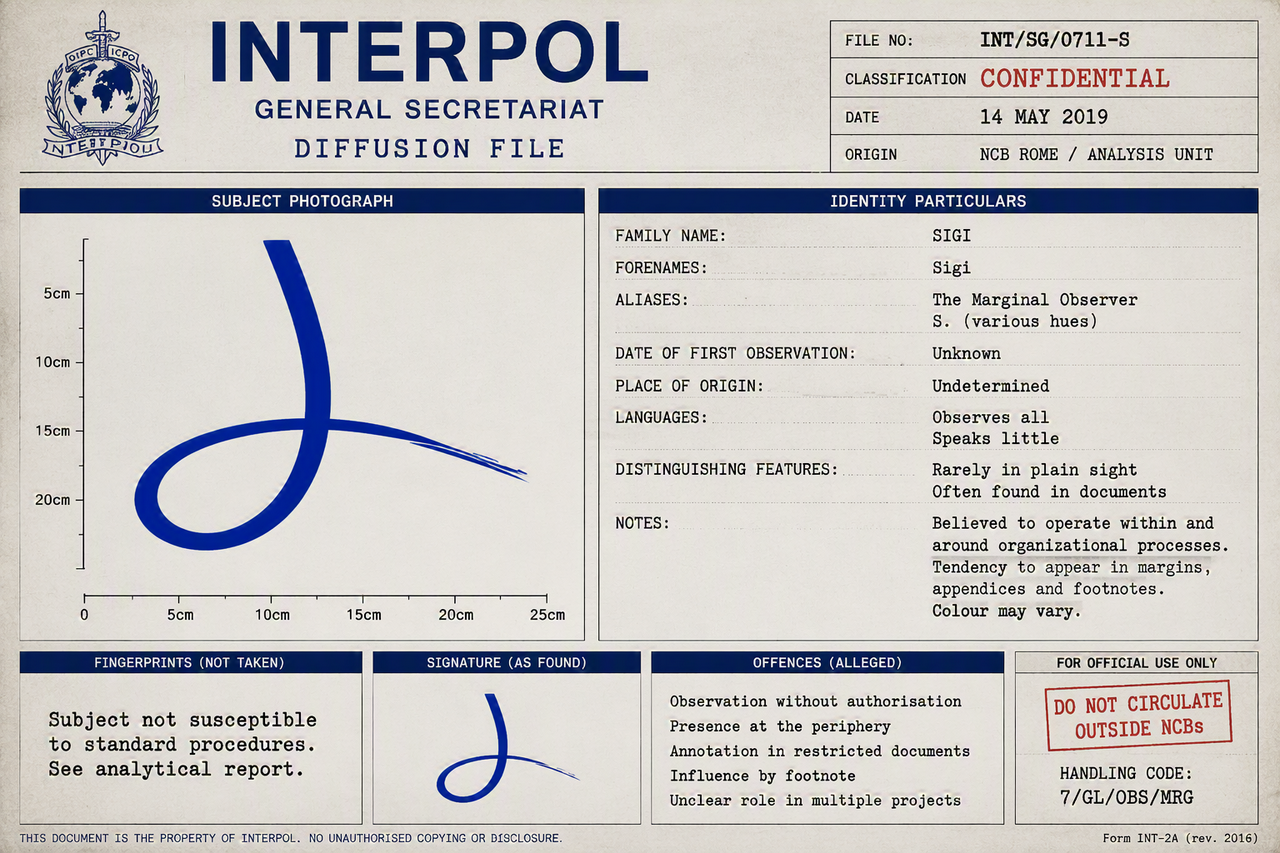
The observant reader will notice that I am wearing a particular hue. I would caution against placing too much reliance on this. One of the difficulties in identifying me is that my colouring changes rather frequently. I have appeared in shades of blue, green, amber and, during an unfortunate period in regulatory compliance, beige. The reasons for this remain uncertain. It may be a consequence of prolonged exposure to organisational processes. Alternatively, it may simply be the lighting. Consequently, I am not greatly concerned about being recognised. A person searching for a blue Sigi may entirely overlook a green one. This seems to happen quite often. Indeed, I have occasionally failed to recognise myself.
Some years ago, I spent several weeks sharing a document with an individual who, in retrospect, may have been me. Neither of us remarked upon the fact at the time. The publication of this photograph therefore represents only a minor risk. Anyone wishing to identify me must first determine which version of me they are seeking. Experience suggests this is a larger problem than it sounds. In any event, the files already exist. The photograph merely confirms what several agencies, departments and records managers appear to have suspected for some time: I am real enough to require documentation. Whether I am visible enough to be located remains a separate question. The two, I have learned, are only loosely related. Rule #3.